 wechat
 request sample
 home
home
contact
0769-83699986
135-3754-4550(mr. zhu)

in communication network equipment, the application scheme of thermal conductive materials needs to be comprehensively formulated according to the equipment power consumption, heat flux density, structural design and cost and other factors, the following are the specific application schemes and analysis:
1. low-power devices (such as 5g small cells, routers)
application scenarios: the device has low power consumption (<50w), heat flux density < 0.5w/cm², and the heat dissipation demand is mainly natural convection or low air speed air cooling.
recommended materials:
thermally conductive silicone sheet
advantages: the thermal conductivity is 0.8-3.0w/(m·k), which can fill the small gap (0.1-5mm) between the heat sink and the chip, and reduce the contact thermal resistance. it has insulation, shock absorption and moisture-proof properties, and is suitable for complex surface bonding. in the cpu cooling of a home-level router, the cpu temperature drops by 15°c and the network performance stability is increased by 30% after the thermally conductive silicone sheet replaces the failed material.
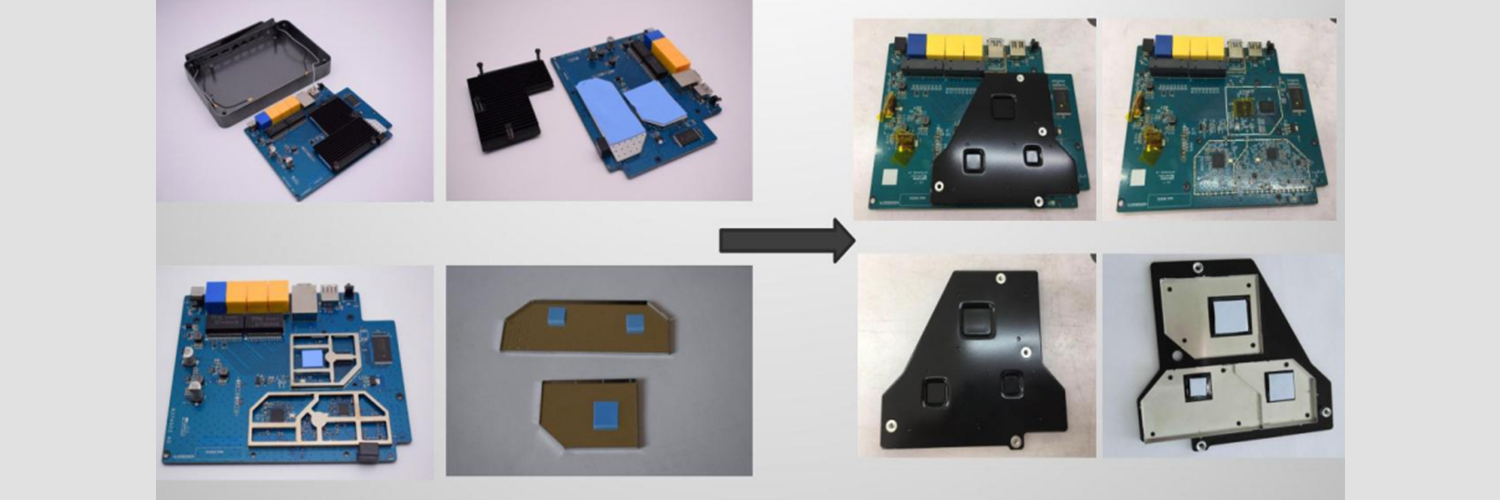
(router thermal conductive silicone sheet overall metal shell thermal management solution)
thermally conductive gel
advantages: compressible to 0.1mm thickness, suitable for filling tight spaces, such as thermal conduction between chip and shield.
example: in the wireless charging module of a mobile phone, the thermal conductivity gel fills the gap between the pcb and the heat dissipation back cover, and the thermal conductivity only decreases by 5% after aging, while protecting the pcb from vibration damage.
2. medium and high power consumption equipment (such as 5g macro base stations, core network equipment)
application scenarios: the power consumption of the device is 50-200w, the heat flux density is 0.5-5w/cm², and forced air cooling or liquid cooling is required to assist heat dissipation.
recommended materials:
high thermal conductivity gel
advantages: it can be compressed to a thickness of 0.1mm, and the thermal resistance is as low as 0.08-0.3°c·in²/w, which can completely fill the uneven surface (such as the tiny gap between the chip and the heat sink, and the phase change thermal conductive interface material), build a continuous and efficient heat conduction channel, and eliminate the hot spot effect.
phase change thermal conductive interface materials (pcmi)
advantages: it is solid at room temperature, and the phase changes to a liquid state after heating, filling micropores, and the thermal resistance is as low as 0.01°c·cm²/w. it is suitable for high-performance processors, power modules, and other scenarios. in the aau module of 5g base station, after pcmi replaces traditional silicone grease, the chip temperature is reduced by 10°c and the power consumption is reduced by 8%.
3. high-power devices (such as data center servers, enterprise-level network equipment)
application scenarios: equipment power consumption > 200w, heat flux density >5w/cm², liquid cooling or two-phase flow cooling technology is required.
recommended materials:
high thermal conductivity gel
aau module application analysis: in aau module, thermal gel replaces traditional silicone grease, fills the gap between the chip and the heat sink, reduces the contact thermal resistance, reduces the chip temperature by 10°c, and reduces power consumption by 8%.
data center server application analysis: high-density computing of data center servers leads to local hot spots, which require efficient heat dissipation to ensure stability. applying thermal gel between the cpu and the heat sink, combined with air or liquid cooling systems, reduces the equipment failure rate by 20-30% and improves data transmission reliability.
application analysis of enterprise-level network equipment: enterprise network switches and routers operate under high load for a long time, and stable heat dissipation is required to prevent communication quality from deteriorating. fill the memory module with thermal gel between the heat sink to ensure that heat is quickly exported and avoid packet loss or delay caused by
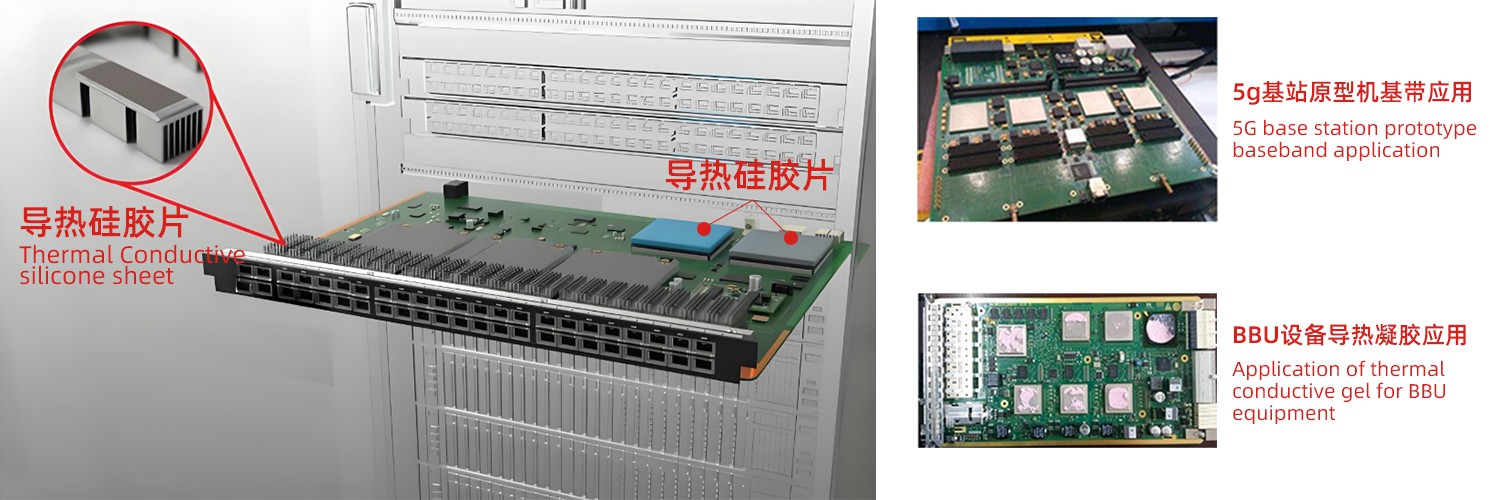
(thermally conductive silicone sheets and thermally conductive gels are used in computing power chips in enterprise-level network equipment)
specific application scenarios | thermal management scheme material application | applied part analysis |
low-power devices (e.g., 5g small cells, routers) | thermally conductive silicone sheet, thermally conductive gel
| handle the gap between the pcb and the heat dissipation back cover between |
medium to high power consumption devices (e.g., 5g macro base stations, core network equipment) | high thermal conductivity gel, phase change thermal conductive interface material
| tiny gaps between chips and heat sinks, phase change thermal conductive interface materials, and micro heat pipes |
high-power devices (e.g., data center servers, enterprise-grade network equipment) | high thermal conductivity gel | aau module fills the gap between the chip and the heat sink |







contact
0769-83699986
135-3754-4550(mr. zhu)

business

business 1

business 2

business 3

technology