 wechat
 request sample
 home
home
contact
0769-83699986
135-3754-4550(mr. zhu)


application scheme of thermal conductive materials in the new energy industry
the application of thermal conductive materials in the new energy industry (with new energy vehicles as the core) needs to focus on efficient heat conduction, insulation safety, lightweight, environmental adaptability and cost balance. the following starts from the three major scenarios of power battery, electronic control system, and charging equipment, combined with material characteristics and technological innovation, and proposes targeted thermal management solutions:
1. liquid cooling of power battery modules is dominant, and material innovation breaks through the bottleneck of thermal management
applicable scenarios: heat dissipation of cells and modules in power batteries to avoid thermal runaway and life attenuation during fast charging and high power output of power batteries.
technical solutions
the liquid cooling system is dominant: the heat dissipation aluminum tube (or cold plate) and coolant (water and glycol mixture) wrap the battery pack through an s-shaped layout, and the thermally conductive silicone sheet fills the gap between the cell and the aluminum tube, eliminating air thermal resistance.
thermally conductive silicone sheet: thermal conductivity 1.0-10.0 w/m·k, filled with spherical alumina or boron nitride particles, taking into account insulation and flexibility, and adapting to battery expansion and deformation.
thermal conductive gel: the thermal conductivity path is simplified to "cell → cold plate", which improves the tightness of the fit and minimizes the level of thermal resistance, and requires the use of high-density and low-viscosity thermal conductive gel.
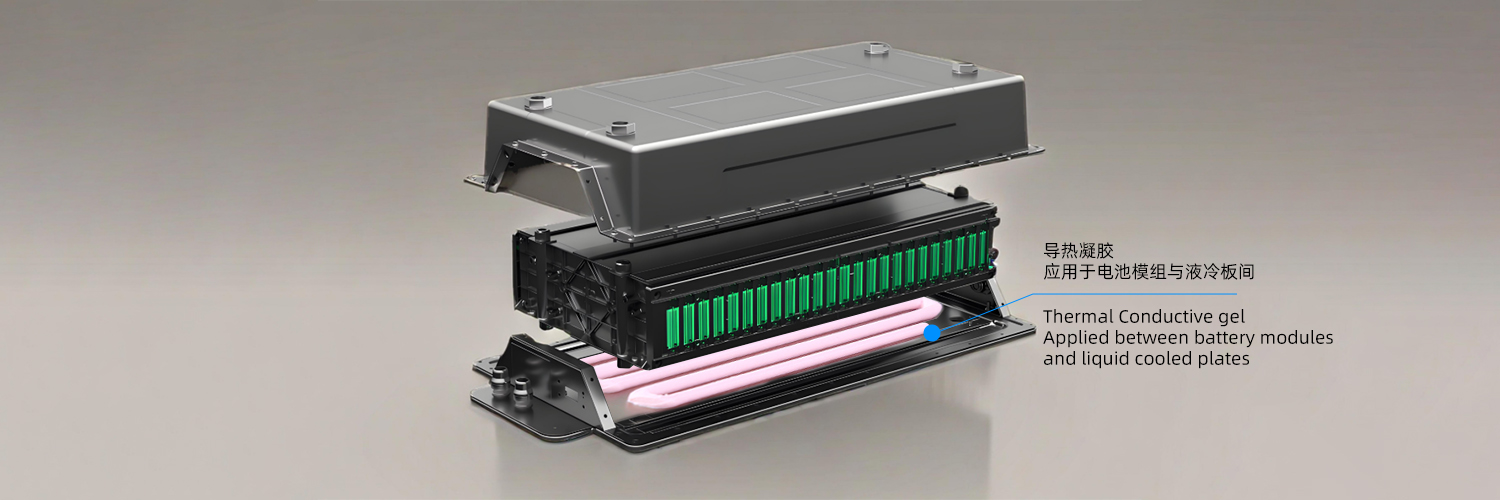
2. heat dissipation of the electronic control system, flexible materials adapted to high integration design
applicable scenarios: high-power electronic device module units such as motor controllers (mcus), inverters, bms controllers, and on-board chargers (obcs).
technical solutions
thermally conductive silicone sheet: it is often used on the surface of the mcu, between the igbt module and the heat sink. the performance usually requires a thermal conductivity of 3-6 w/m·k, a breakdown voltage of >5kv, and a compression ratio of 20%-50% to adapt to complex surfaces.
thermal conductive gel: suitable for electronic modules such as bms controllers and on-board chargers (obcs). the performance usually requires a thermal conductivity of 1~10 w/m·k, low oil output, low volatility, excellent caulking performance, and a small gap (<0.3mm).
structural adhesive and potting adhesive: application scenarios include motor stator and electronic control module packaging, general thermal conductivity requirements of 0.8~4.0 w/m·k, flame retardant ul94v-0, good foaming performance to avoid cavity thermal resistance.

(thermal management structure of thermally conductive silicone sheet applied locally by bms controller)
3. charging equipment heat dissipation, phase change materials and thermal conductive insulation materials to cope with instantaneous high heat
phase change materials (pcm): mainly used in charging modules, battery cell packaging and other modules, compounded with aluminum heat sinks to achieve the integration of "absorption-conduction-dissipation".
thermally conductive insulation materials: mainly including thermally conductive silicone sheets, flame-retardant silicone sheets, thermally conductive potting adhesives, etc. it is mainly used between the contact point of the charging gun, the power device and the shell. the performance requirements are thermal conductivity of 1-3 w/m·k, breakdown voltage > 10kv, and temperature resistance range of -40°c to 200°c.
specific application scenarios | thermal management scheme material application | thermal management solution advantages |
heat dissipation of cells and modules in power batteries | liquid cooling system dominance thermally conductive silicone sheet thermal conductive gel | the lightweight structure, |
motor controllers (mcus), inverters, bms controllers, on-board chargers (obcs) and other high-power electronic device module units | thermally conductive silicone sheet thermal conductive gel structural glue or potting adhesive | adapt to complex surfaces |
charging modules, cell packaging and other modules | phase change material (pcm) thermal insulation material (thermally conductive silicone sheet, flame retardant silicone sheet, thermal conductive potting compound, etc.) | wide |
prev:







contact
0769-83699986
135-3754-4550(mr. zhu)

business

business 1

business 2

business 3

technology