 wechat
 request sample
 home
home
contact
0769-83699986
135-3754-4550(mr. zhu)

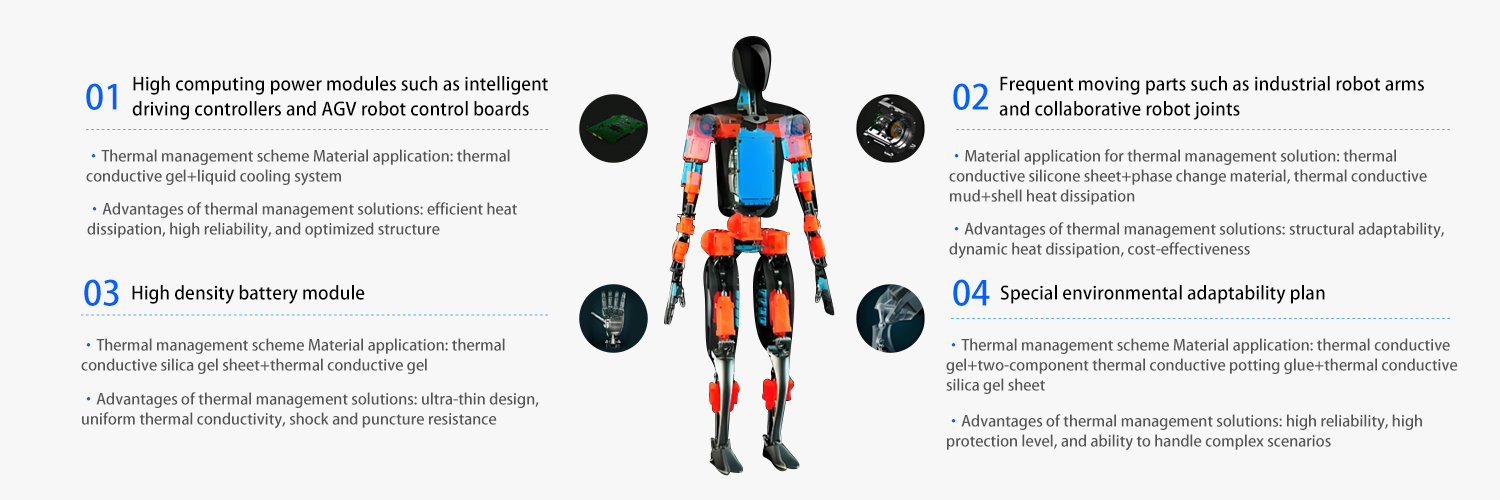
application scheme of thermal conductive materials for robots
thermal management solutions in the robotics industry need to combine application scenarios, heat source characteristics and system constraints, and adopt a hierarchical design strategy covering materials, structures, active/passive cooling technologies and system optimization. in robot heat dissipation design, the selection of thermal conductive materials needs to comprehensively consider thermal conductivity, structural adaptability, long-term stability, and cost-effectiveness. the following mainly provide corresponding solutions for key robot components.
1. core controller and processor heat dissipation: thermal conductive gel liquid cooling technology
applicable scenarios: high computing power modules such as intelligent driving controllers and agv robot main control boards.
technical solution: thermal conductive gel liquid cooling technology
thermal conductive gel: through the composite of silicone resin substrate and alumina filler, the 0.5-3mm gap adaptive filling is realized, and the thermal conductivity reaches 3-12w/m·k. its paste-like characteristics can completely cover the small gaps between the chip and the heat dissipation frame, reducing thermal resistance to less than 0.05°c·cm²/w.
liquid cooling system: coolant circulation takes heat away from the radiator, and the heat conduction efficiency is 3-5 times higher than that of traditional air cooling, especially suitable for compact spaces such as 4680 cells.
advantage:
efficient heat dissipation: the thermal conductive gel quickly transfers heat to the core components, and the liquid cooling system provides efficient heat dissipation channels.
high reliability: thermal conductive gel is resistant to high temperature, vibration, and aging, and is suitable for complex automotive working environments.
structural optimization: the liquid cooling system distributes the temperature evenly, avoiding local overheating and extending the life of the equipment.
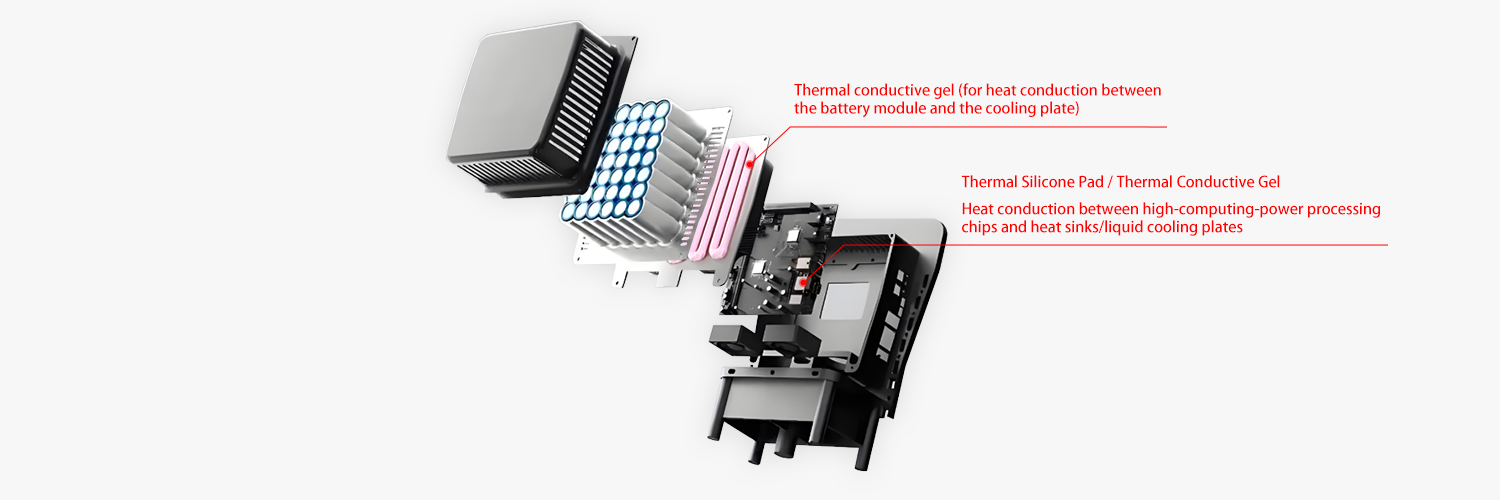
(analysis diagram of the application of thermal conductive interface materials for robot high-computing power chips and high-density battery modules)
2. heat dissipation of robotic arm and motion module: thermally conductive silicone sheet phase change material, thermal conductive gel shell heat dissipation
applicable scenarios: industrial robotic arms, collaborative robot joints and other frequently moving parts.
technical principle: thermally conductive silicone sheet phase change material, thermal conductive mud shell heat dissipation
thermal conductive gel: through its paste-like, non-curing and non-powdering characteristics, the thermal conductive gel can completely cover the small gaps between the chip, mcu, mos tube and other high-heat source areas and the heat dissipation frame, and cooperate to reduce thermal resistance and avoid the accumulation of local high heat sources.
thermally conductive silicone sheet: fill the gap between the heat source and the radiator with a thermal conductivity of 1.2-25w/m·k, and its softness and high compressibility (compression rate up to 50%) can adapt to uneven surfaces it also provides insulation, shock absorption functions, and is less costly.
phase change materials (pcms): paraffin-based composite pcms absorb heat and undergo phase changes when the temperature rises, filling the interfacial voids and reducing thermal resistance. its latent heat absorption capacity reaches 200-300kj/kg, which can inhibit temperature surges by 30%.
advantage:
structural adaptability: the material of thermally conductive silicone sheet is soft and can be bent and cut, and it is suitable for complex mechanical structures of robotic arm joints. thermal mud can be applied to small and high-heat source areas in the interior through its paste-like non-curing characteristics to avoid overheating and damage to components.
dynamic heat dissipation: the phase change material automatically adjusts its state according to the temperature to adapt to the intermittent high-load working conditions of the motion module.
cost-effective: the cost of thermally conductive silicone sheets is reduced by 40% compared to liquid-cooled systems, and the maintenance cycle is extended to more than 5 years.
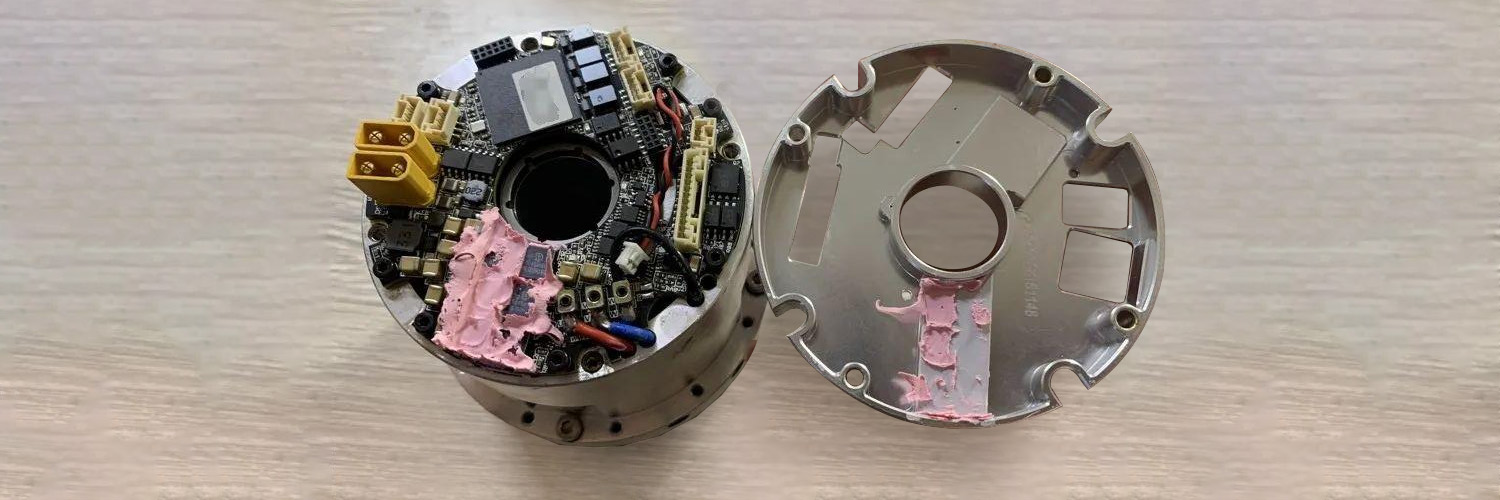
(thermal conductive gel is used in the high heat source area of the mcu and mos tube in the crossed roller bearing)
3. heat dissipation of high-density battery modules: thermally conductive silicone sheet thermal conductive gel
applicable scenarios: high-density battery modules for humanoid robots
technical principle:
thermally conductive silicone sheet: thermal conductivity 1.0-10.0 w/m·k, filled with spherical alumina or boron nitride particles, taking into account insulation and flexibility, and adapting to battery expansion and deformation.
thermal conductive gel: the thermal conductivity path is simplified to "battery cell → cold plate/shell" to improve the fit tightness and minimize the level of thermal resistance, and a high-density, low-viscosity thermal conductive gel is required.
4. special environmental adaptability plan
1. extreme temperature environments (-40°c to 200°c)
thermally conductive gel: through the modification of silicone resin substrate, zero-stress bonding under extreme working conditions from -40°c to 200°c can be achieved to avoid material shedding caused by thermal expansion and contraction.
two-component thermal adhesive: thixotropic, does not flow after dispensing, and can fit interfaces of different heights after pressing, suitable for scenarios with uneven pcb interface heights such as wireless charging pads.
2. moisture protection and insulation needs
thermally conductive silicone sheet: moisture-proof and insulating properties (breakdown voltage >10kv/mm), suitable for outdoor robots or humid environments.
thermally conductive potting compound: encapsulate and protect key components such as joint actuators, drive motors, sensors, etc., which can achieve ip67 waterproof and thermal conductivity of 1.5-3.0w/m·k.

(silicone potting compound encapsulation inside the robot sensor)
specific application scenarios | thermal management scheme material application | thermal management solution advantages |
high computing power modules such as intelligent driving controllers and agv robot main control boards | thermal conductive gel liquid cooling system | efficient heat |
industrial robot robotic arms, collaborative robot joints and other frequently moving parts | thermally conductive silicone sheet phase change material thermal mud shell heat dissipation | structural adaptability dynamic cooling cost-effectiveness |
high-density battery modules | thermally conductive silicone sheet thermal conductive gel | ultra-thin design uniform thermal conduction shockproof and puncture-resistant |
special environmental adaptation program | thermally conductive gel two-component thermally conductive potting compound thermally conductive silicone sheet | high reliability |







contact
0769-83699986
135-3754-4550(mr. zhu)

business

business 1

business 2

business 3

technology